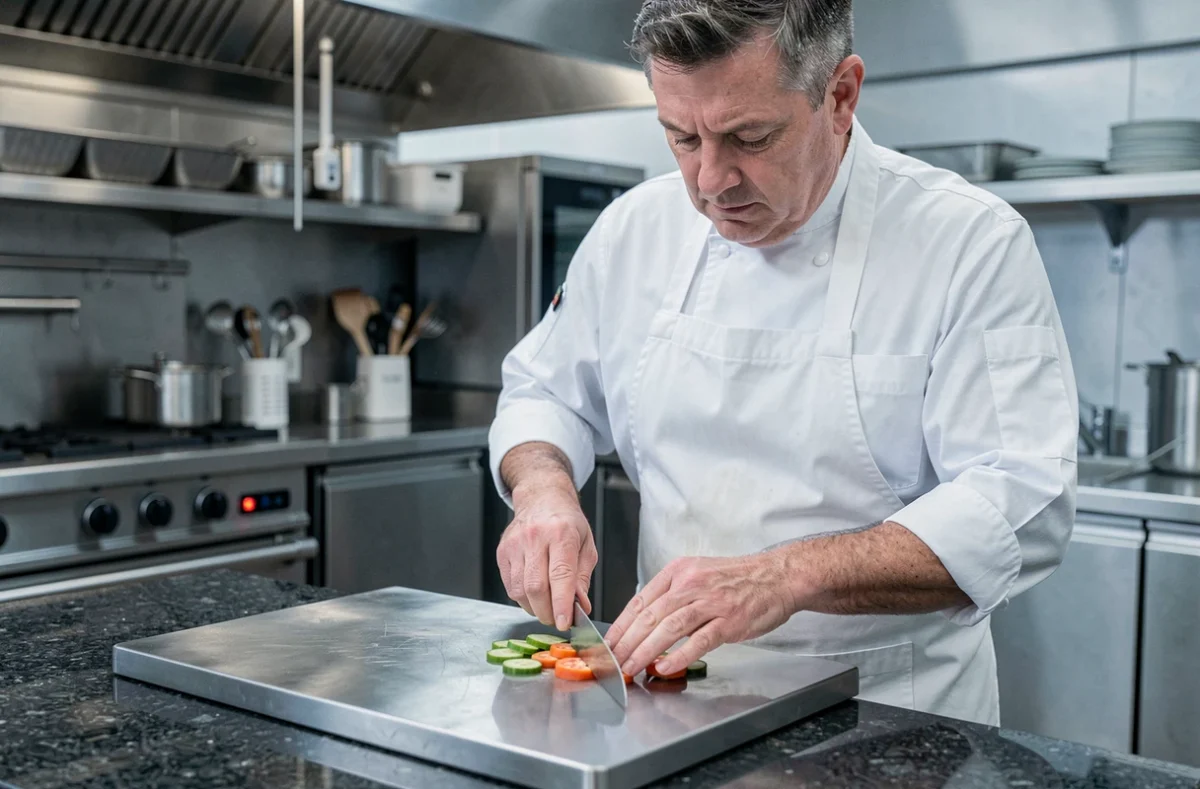
A titanium cutting board attracts attention with its promises: impeccable hygiene, extreme durability, zero microplastics. However, as soon as you place a knife on it, the feedback diverges. Between effective marketing and kitchen reality, titanium deserves careful examination, particularly regarding blade wear and the reliability of products sold under this label.
Pure titanium or disguised steel: the problem of fake boards
Before even discussing health risks or knives, the first question concerns what you are actually buying. A test published by America’s Test Kitchen in July 2026 examined five metal boards sold as titanium or stainless steel. The result: two of the three models presented as “titanium” were actually made of stainless steel, identified by their density and dimensions.
Pure titanium is significantly lighter than stainless steel. If your board is abnormally heavy for its size, that’s a clue. Serious manufacturers mention the exact grade (often grade 2, pure titanium over 99%). Without this information, it’s better to walk away.
To delve deeper into the dangers of titanium cutting boards, the composition of the material remains the starting criterion: a stainless steel board sold as titanium does not offer the same guarantees of biocompatibility.
Knife wear on a titanium board: what the tests show
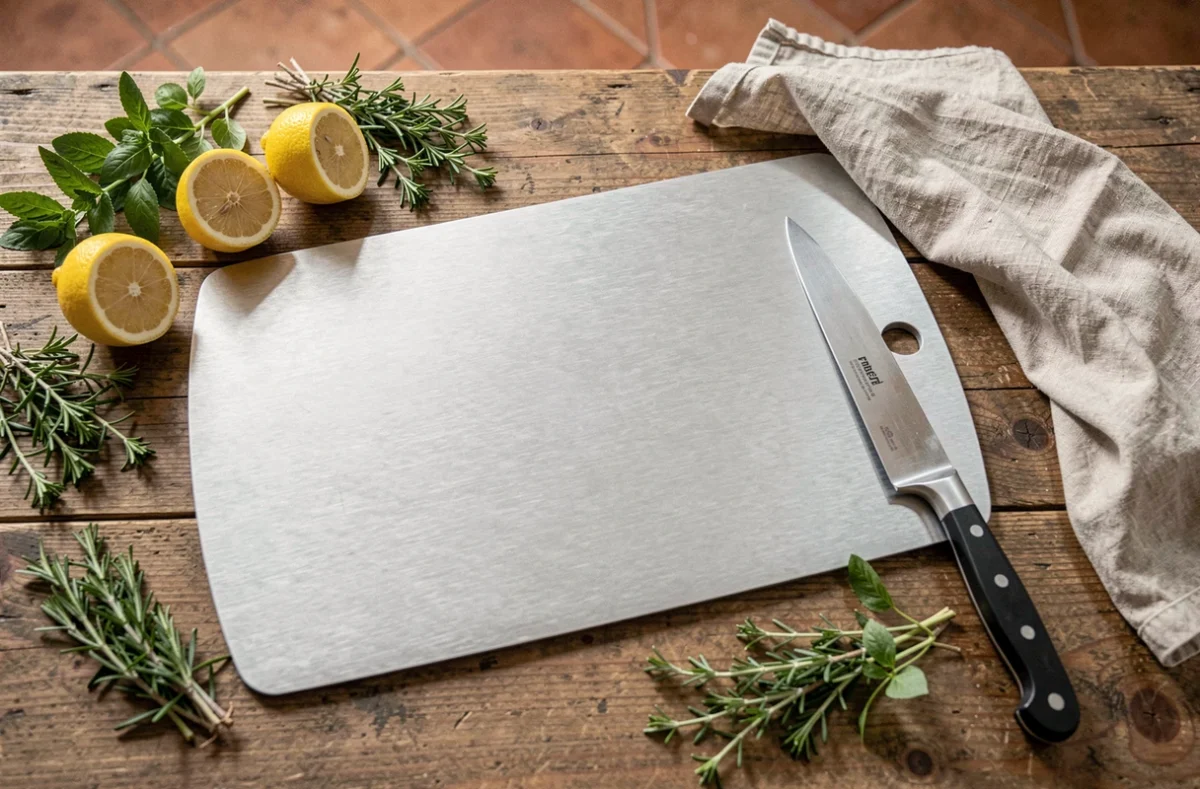
Have you ever noticed that a knife dulls faster on certain surfaces? The material of the board plays a direct role. Wood slightly absorbs the edge of the blade, preserving it. Titanium, even though it is softer than the hardened steel of a good knife, remains a rigid metal surface.
A study published in September 2025 by Prudent Reviews documents this phenomenon precisely. After 300 back-and-forth cuts and 300 chops, the loss of sharpness measured in BESS points reached 444 points on titanium, compared to 41 on maple and 15 on end-grain walnut. The difference is considerable.
Why such a result when titanium is softer than the steel of the blade? The rigidity of the surface matters as much as its hardness. A rigid material does not yield under the knife’s edge. The energy of each cut concentrates on the edge instead of dispersing into the board. Wood, on the other hand, “welcomes” the blade by slightly compressing.
In practice, using a titanium board requires sharpening your knives much more often. For an amateur cook who rarely sharpens their blades, switching to titanium can turn a high-performing knife into a dull one within a few weeks of daily use.
Hygiene and food safety of titanium compared to wood and plastic
Pure titanium is a biologically inert metal. It does not react upon contact with food acids (lemon, tomato, vinegar), does not oxidize, and does not release any compounds into food. This is why it has been used for decades in surgical and dental implants.
Compared to other common materials in the kitchen, titanium has clear advantages in terms of hygiene:
- Zero microplastics: unlike plastic boards, titanium does not crumble under knife strikes and does not release any particles into food
- Non-porous surface: titanium does not retain moisture or bacteria in grooves, unlike wood which can develop grooves over time and harbor germs in its crevices
- No chemical treatment necessary: no glue, no varnish, no PFAS or bisphenol, unlike some low-quality composite or plastic boards
- Dishwasher safe without degradation, simplifying regular disinfection
However, wood has documented natural antibacterial properties (some species like walnut trap and neutralize bacteria on the surface). Titanium does not kill bacteria; it simply prevents their accumulation due to its non-porosity.
Noise, slipping, and everyday comfort of use
One point rarely mentioned in product descriptions: noise. Cutting on a metal surface produces a dry, metallic sound, significantly louder than a wooden block. In an open kitchen, after a few minutes of preparation, the acoustic difference can become annoying for some users.
Stability is also a concern. A thin titanium board placed on a smooth countertop tends to slip. Some models incorporate non-slip pads, but this is not always the case. A damp cloth under the board solves the problem, just like with glass or stainless steel.
In terms of weight, titanium is much lighter than stainless steel. This is actually a simple way to verify the authenticity of the material. However, this lightness also means less inertia: the board moves more easily under vigorous chopping than a solid wooden block.
Choosing a titanium board: the criteria that matter
If you are considering a purchase despite the knife concerns, a few points deserve systematic checking:
- The explicit mention of the titanium grade (grade 1 or grade 2, pure titanium over 99%) on the product sheet or packaging
- The weight relative to the dimensions: an abnormally heavy board for its surface is likely made of stainless steel
- The presence of non-slip pads or a textured coating on the underside
- Sufficient thickness to avoid bending during use, without exceeding a weight that would negate the advantage of titanium’s lightness
An authentic titanium board is especially suitable for cooks who are willing to regularly maintain the sharpness of their knives. For those who prioritize blade preservation, end-grain wood (walnut, maple) remains the reference material. Titanium finds its place as a hygienic supplementary surface, for example for cutting raw meat, where ease of cleaning takes precedence over cutting comfort.