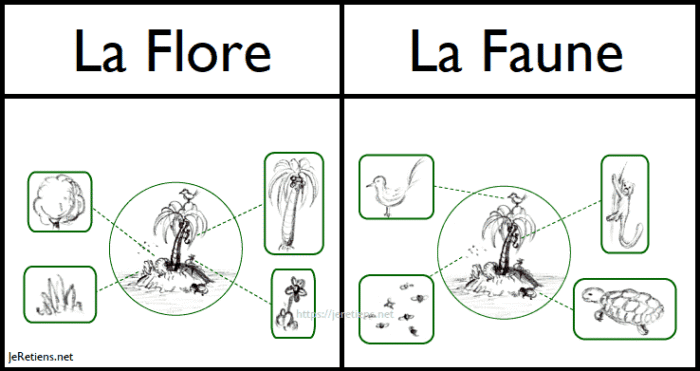
Flora is the term used to study the life of plants living in a given area or region, while fauna refers to the study of animal life living in any geographical area. Schematically, all kinds of grasses, trees, and plants fall under flora, whereas all kinds of animals, birds, and insects fall into the category of fauna.
Although biota is the term used to refer to complete life forms such as fungi, bacteria, etc. Fauna and flora ecosystem are scientific terms. In general, we use the term plant and animal life. The biological community flora and fauna where living beings interact with each other also play an important role in the terrestrial ecosystem.
Fauna and flora are living organisms and belong to the category of eukaryotes; they also share characteristics.
Article content
- What is flora?
- What is fauna?
- Differences between fauna and flora
- Commonalities between fauna and flora
- Conclusion
What is flora?
Flora refers to all types of plants found in a specific area. A flora can include scientific names as well as common names, habitats, descriptions, geographical distributions, blooming periods, favorable climates, and other illustrations.
Flora also refers to information about the plant’s reproduction time, its family, its number of chromosomes, etc.
 Examples of the flora of an island.
Green plants are essential resources on earth. They serve as raw materials for food, medicine, and play a vital role in stimulating the economy. Plants are useful for inducing rain, protecting soil erosion, and balancing the ecosystem. Plants are habitats for many animals, especially birds. Today, about 400,000 plant species have been identified, and it is estimated that 10% remain to be discovered.
Indigenous flora, horticultural flora, and weeds vary and differ according to the region and climate. Indigenous flora is the native species or subdivision of flora. As its name suggests, endemic flora grows in a particular region. Horticultural flora consists of weeds cultivated by humans. Weeds consist of undesirable plants.
What is fauna?
The term fauna refers to all animals living in a particular region. This term was coined by the Swedish zoologist Linnaeus (Carl von Linné), known for his system of classification of species.
Fauna depends on flora for its food and is called heterotrophs.

Like flora, fauna is also subdivided into several categories based on animals living in certain regions or areas. These subdivisions are megafauna, microfauna, mesofauna, avifauna, piscifauna, and cryofauna. Examples of the fauna of an island.
Megafauna includes the largest animals, microfauna includes microorganisms and the smallest animals, mesofauna includes invertebrates and soil organisms, avifauna includes species of birds, piscifauna is related to fish, and cryofauna consists of animals that live near ice.
Differences between fauna and flora
The following points differentiate flora and fauna:
- Flora refers to the natural vegetation, including plants, fungi, and algae of a given geographical area, while fauna refers to the animal life living in a specific region or geographical area.
- Flora is studied in the field of botany, and the person who studies it is known as a botanist. On the other hand, fauna is studied in zoology, and the person who studies this subject is known as a zoologist.
- Green plants are classified in the category of flora and are producers or autotrophs and can prepare their own food using sunlight, while fauna is the umbrella under which animals, insects, and birds are kept, and these are consumers that depend directly or indirectly on green plants.
- Flora is the first form of life that appeared on Earth, according to the chronological history of the planet, while developed fauna is said to have come after flora, as it depends on them for food.
- Flora is not mobile, while fauna is mobile and can move from one place to another.
- The cell wall and chloroplast are present in plant cells; they are absent in animal cells, where instead of chloroplasts, mitochondria are present, which are used to store energy.
- Grasslands, forests, flowering and non-flowering plants are examples of flora. Birds, animals, fish, insects, etc., are part of the fauna.
Commonalities between fauna and flora
Fauna and flora breathe. Fauna and flora reproduce. Fauna and flora are composed of animal or plant cells. Fauna and flora grow, respond to stimuli. Fauna and flora exchange energy with the environment.
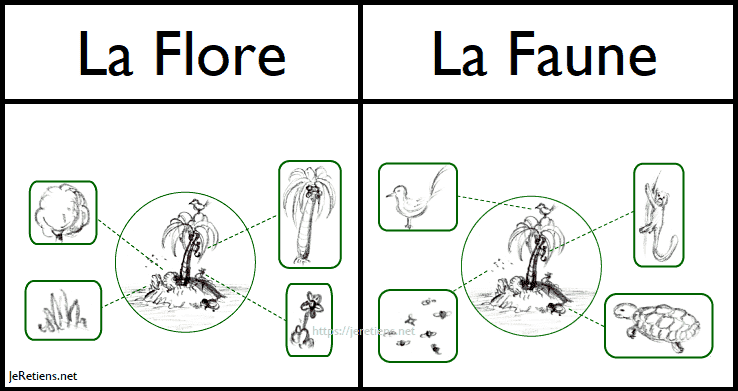
Illustration of the difference between fauna and flora. In the case of this image, it is about the fauna and flora that can be found on an island. Conclusion
In this article, we discussed flora and fauna, their differences, and their similarities. We learned about their importance and contribution to our ecosystem. Another fact is that due to the increasing population, many species of flora and fauna have disappeared, and many are on the verge of extinction. Therefore, it is necessary to preserve them in order to maintain ecological balance.
Tag: understand the difference between flora and fauna