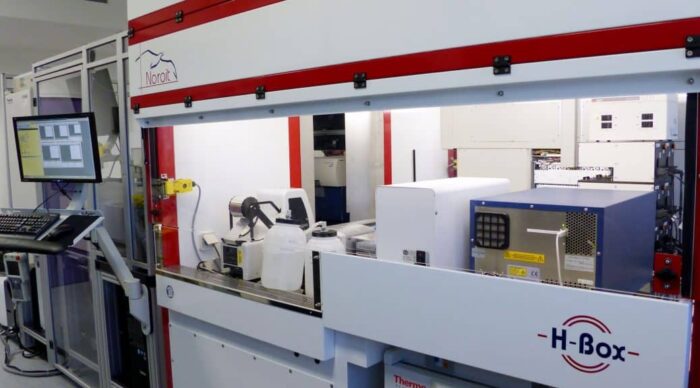
Microbiological safety cabinets, also known as BSCs, are designed to protect an operator and their environment from hazards related to aerosols during the handling of infected or hazardous biological active substances, with the exception of some radioactive substances. Today, there are several types of microbiological safety cabinets, each serving its purpose. The question to consider is what these different types of microbiological safety cabinets, also called BSCs, are actually for.
The utility of Type I safety cabinets
Type I safety cabinets simultaneously ensure the protection of the operator and the atmosphere by creating an airflow that enters the enclosure to expel the normal airflow that was inside the enclosure, thanks to a very high-efficiency filter. However, this type of microbiological safety cabinet does not protect the product being handled. Thus, the product is directly exposed to air coming straight from the laboratory.
The utility of Type II microbiological safety cabinets
Type II microbiological safety cabinets provide protection for the operator through a suction created at the front edge of the work surface. This constitutes a protective barrier between the operator and the manipulation, albeit immaterial. This type of microbiological safety cabinet also protects the atmosphere by expelling the airflow out of the enclosure through a very high-intensity filter.
In addition to all this, the Type II microbiological safety cabinet protects the product being handled from contamination through a very high-intensity vertical unidirectional airflow. This is crucial because product contamination could arise from the atmosphere or from contamination by other types of products being handled at the same time. Thus, the Solis microbiological safety cabinet from the Noroit brand is one of the most reliable BSCs that a laboratory can have.
The role of Type III microbiological safety cabinets
Type III microbiological safety cabinets, on the other hand, secure the operator by creating a completely enclosed volume. They also secure the product by supplying the enclosure with very high-intensity air.
However, here, the atmosphere is secured by expelling airflow out of the enclosure through two very high-efficiency filters placed in series. Nevertheless, the Type III microbiological safety cabinet does not provide protection for the product against cross-contamination. This is due to the absence of unidirectional airflow within the enclosure.
Thus, all microbiological safety cabinets have different levels of protection depending on their types.